Monday, June 23, 2014

Mutton Mowers

I've long felt that the use of gasoline for the mowing of lawns will one day be widely seen as one of the most shameful ways to squander our limited energy sources, our atmosphere's capacity for carbon, and thus the lives of our children.

For most of my life, my family had a nearly 1 acre lawn which I despised mowing (though my disdain lessened somewhat with the arrival of a riding lawnmower), and for which I developed numerous creative ideas for avoiding.   My father didn't approve any of the ideas though, so mow it we did.

So it was that the purchase of our farm and the accompanying lawn came with a challenge.   Do we mow it like everybody else and thus fall into this same trap?   Do we mow it with our 14" wide antique push reel mower that can't handle any grass over 5 inches, or spend hours to mow it with scythes?   Let it go "natural" and make someone think our house has been abandoned?  Or, should I just let it go a month or two and then brush hog it with the tractor?  (which I'd already tried)

As it turns out, we had a better solution in hand -- mow it with sheep! (which, btw, is how the original lawns were maintained centuries ago, before they became a status symbol)   It just took a little time to implement.   Last summer, we fenced in the front of the yard.  We wanted it to look presentable yet still hold livestock, so went with a split rail fence supplemented with hi-tensile wire between the rails.  It's old growth cedar from British Columbia, stocked by the local Menard's Hardware.   Not the best solution, but the one that worked best with our limited time.  We do have enough sassafras that we could've made a similar fence from our own trees, but I wasn't able to spare the time for it.

This left our driveway as the remaining escape route to be filled, so we needed a gate.   Having admired a "Sussex farm gate" made on the Woodwright's Shop on PBS, and having some white oak on hand from trees we logged a couple years ago, I set to work over the winter.   The entire gate was made exclusively with hand tools, with all joints using mortise & tenon construction (side gate excepted).  Yes, it's slower, and yes, it's much more enjoyable and satisfying than working with power tools.  It's also a good idea to work on such skills before they become the only option, as the energy sources for our electric grid start to wane.  (Ha ha!  Just joking -- that will never actually happen.  Ever)

So with the gate completed, we just needed some appropriate hinges.   I thought this would be a great application for my burgeoning blacksmithing skills, but we found a pair of perfectly sized strap hinges at an antique shop for a good price, and those were put to use.  My smithing was needed only for the pintle hangers.

With the gate up, it also seemed like a good idea to put up the farm sign I'd long planned on, in case anyone looking for our farm expected to see a sign proclaiming its presence.

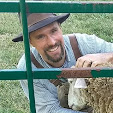
Everything made it into place before the grass started to get too long this year, so we set the sheep to work before any mower touched the lawn.  What's it like?

Well, just as you might imagine, it's pretty cool not to have to mow your lawn.  It's also neat to add an acre to our "pasture", as our flock of sheep has grown to nineteen or thereabouts with this year's lambs.  I'm still getting used to the mysterious "nom, nom, nom, grunt!" sounds that come in through our open windows in the wee hours of the morning though, along with the occasional "baaaa!".

Do they do a good job?  Yes, for the most part.  The trimming job around the base of trees, fences, and parked farm implements is much better than any human could accomplish.  They're also tackling the brush around our new barn site, which is a big plus.  There are a few things which get left;  a seed stalk here, or a less-than-tasty weed there, but many parts of the lawn look like a putting green when they're finished. 20 minutes of touch-up with a sharp scythe takes care of the small patches of overlooked ground.

The downside is that sheep aren't partial to just grass.   Lots of landscaping (roses, dogwood, mock orange, etc) are also quite tasty, and got unwanted trimming on the first mowing session.  For those we just put together a cage made of woven fence wire held up by old metal "T" posts, which seems to do the trick.  Most of our other landscaping plants, as it turns out, don't taste all that great.

I suppose the presence of turds in the lawn would be offensive to some, but sheep berries seem pretty innocuous to someone for whom cowpies have become an accepted hazard.  The fertilizing effect of animals on grass is also a great benefit, and seems to far exceed the effect of lawn clippings.

So is it the perfect solution?   Nope, but it's a good one, and far better than the gasoline lawn mower solution that most folks still cling to for the time being.   As an added bonus, Clover (our border collie) likes the fact that each window in our house now is now tuned to "sheep TV".


Thursday, April 24, 2014

Does honoring our past preserve our future?

Over the many millenia of our existence, humans have become adapted to a certain way of living.  When we follow that precedent, we're happy and healthy.   When we stray from it, our physical and mental health declines, and our society suffers.

The industrial revolution, driven as it has been by human wants and desires, would seem as if it should follow this pattern and enhance our lives.  It has certainly enhanced many aspects of them, but like everything in life, it came at a cost.  While it's allowed many of us a temporary reprieve from our old nemeses of disease and starvation, it has also deprived us of the meaningful existence we once had.

Two critical elements of the human experience were all but destroyed by the industrial revolution, and need to be reclaimed if we're to again be a healthy society with a bright future.

First and perhaps foremost, is community.  Humans did not travel large distances on a daily basis, but remained in a relatively small area, aside from seasonal migrations.  I would think that a "home range" with a radius of perhaps 10 miles would have been the norm.  The people you grew up with were the people you grew old with, fostering a familiarity with everyone in your limited range.

Studies I've seen suggest that people are most comfortable in groups of up to about 150 individuals.  Beyond that we have difficulty remembering faces and names. People become anonymous, and concern for the well being of anonymous people is much reduced. The sense of community diminishes the more we travel, and the more people we interact with on an impersonal basis.

It's the protection of this all-important community that has driven the Amish culture to eschew the ownership of cars and tractors.  It's at the core of their success as a culture, and has nothing to do with a rejection of modern technology as most Americans assume.  The use of buggies instead of cars limits the possible distance for any travel, forcing their community to remain physically close together.  The rejection of tractors for field work (some districts do allow them for barnyard and stationary tasks) has had a similar effect because it limits the amount of work which can be accomplished by a single farming family.  This, in turn, keeps farm sizes small, which in turn allows neighbors to remain near each other.

The second element which I think is critical to human health is the ability to directly meet the needs of our own existence.  Don't get me wrong;  people have always been social creatures, and nobody ever provided *all* of their own individual needs.  Until recently, however, we have been able to provide much of what we needed on our own, and those needs we couldn't meet ourselves were invariably met by others within our family or tribe who could meet them.  We are producers by nature, not consumers.

Our efforts were tangible and had direct effect, whether hunting and gathering or growing our own food, making our own shelter, clothing, medicine, or entertainment.  Why is it important that we have this close and direct connection with providing for our own needs?  Pride.  A sense of accomplishment and empowerment. Traits that have all but vanished in the consumer society.

Perhaps of even greater importance, is the fact that such activities tie us to the very foundation of life, and thus ensure a reverence for that which sustains us.  "Nature" isn't a place you visit, or Disneyland's competition for your next vacation.  It's your life support system.  The fact that most Americans value the economy more than the preservation of life support systems represented by nature is nothing short of asinine.

I suspect that millions of Chinese people are now discovering this truth the hard way, as their air is no longer breathable, their food contaminated, and their water undrinkable.  On the bright side, they do have the worlds fastest growing economy though, eh?

Tuesday, April 15, 2014

Industrial vs. Local

The industrialized food system that sustains us all is clearly an abomination to anyone who has bothered to educate themselves and scrutinize it.  Most that I know have not and will not do so, because knowing what's behind that curtain will force changes they aren't willing to make.  Its only real proponents are those who are using it to line their pockets at our expense. It's only "cheap" when you ignore the fact that it damages not only our health but threatens our very existence.  The farmers I've met who are a part of it are rarely enthusiasts, but rather cogs in the machine that they cannot separate themselves from.  Most know little of the chemicals they use (often not even their names, in fact, as much spraying is outsourced), and I suspect that's in large part due to a desire *not* to know.  They know full well that such knowledge might force them to end their use in order to maintain a clear conscience, and thus lead to financial ruin.

So what about the small "local" farms that are the darlings of any local/sustainable foodie?  Show me one, and I'll point out some fundamental shortfalls, many of which I'm intimately familiar with.  Almost without exception, they're purchased and/or sustained with an inheritance, the proceeds from a previous well-paid career, or a spouse who kept their "regular" job and family health insurance. Many work to promote the sustainability image while making significant short-cuts, whether that's the liberal use of diesel fueled equipment, the use of chemically grown feed for their pastured livestock, or poorly compensated intern labor.  The well known Joel Salatin scores a hit on nearly all of these (inherited farm, chemically grown feed, lots of diesel fuel, and loads of interns).

Doubling your food budget by going organic and/or local doesn't really cut it, as these farms are not truly viable even at their seemingly inflated prices. The fact of the matter is that producing food responsibly makes it just as expensive as it was historically, when people typically spent 40-50% of their income on food rather than the current 10-15%.  Historically, farmers (of which most were and will again be) had significant advantages as well.  A lower population made for a greater relative resource base, with consequently lower land costs. A pre-industrialized atmosphere made for greater climate stability and better odds of a successful crop.  The inter-generational accumulation of farming knowledge was unbroken as well, though perhaps the internet will fill some of that gap for us while it's still around.

It probably goes without saying, but a return to spending 50% of our income on de-industrialized food means big changes are in store.  That nice big house will be traded in for something more like the size of a typical garage, or will become a multiple family residence, or -- even more likely -- abandoned in favor of a location with enough land to grow food.  Forget about the car (or paved roads to drive it on), washing machines, retirement, or most anything that has arrived on the scene in the last 150 years.  Forget about the MRI for that head injury, or drugs for dealing with depression.  There'll be no stairmaster or gym membership, and no need for either. There'll be no closet full of plastic clothes from China, cell phones, nor TVs for whiling away your days and fomenting a desire for consumer goods (you'll be too busy anyway).  It'll be no panacea, but many of the changes will undoubtedly be big improvements over the status quo, probably making it a wash overall.

Can we return there?  Should we?  Do you think we really have a choice?

Sunday, April 13, 2014

So long, winter!

The snow is finally melted, and we're done with maple sugaring for the season.  The frogs are out, daffodils are blooming, pastures are greening up, peepers are going wild, the barn swallows are back, and the toads in our barnyard pond serenade me with their impersonation of a Jetson's car while I milk in the morning.  Spring is nice.

Sunday, February 2, 2014

Worth Watching

A few months back, Robin Wood blogged about a BBC series in which he was featured, called the"Tudor Monastery Farm".  It looked very interesting, but alas was not available in the US.   Since then, all of the episodes have appeared in full on Youtube.   There are 6 episodes each of the Tudor Monastery Farm, the Victorian Farm, Edwardian Farm, and Wartime Farm (notice a common theme here?).

Henry noted that the series is like a collection of our home videos (which is fairly accurate, especially the Victorian series), and seems to enjoy them as much as Rachel and I do.   We've learned quite a bit, and have been impressed with the detail that goes into each show as the historians recreate the practices of each period.  The progression of technology up through the industrial revolution (and especially before) is quite an eye opener, as are the differences with practices here in the US.  These will definitely be of interest to anyone with an interest in history, or the inkling that it might present a closer approximation of our post-oil future than Star Trek.


Tuesday, January 21, 2014

Your Farm

In conversations about environmentalism and the power of an individual to change the world, I often hear it noted that the good any one of us do is inevitably undone by the overwhelming tide of humanity, most of whom aren't so idealistically inclined.  We're all going to hell in a handbasket anyway, so why make our lives difficult on top of it all?  Damn the torpedoes!  Live life to the fullest, eh?  (imho, a purposefull life is much fuller than a guilt ridden free-for-all, but that's another discussion)

At other times, people relating to our farming adventures note that they can't just go and buy a farm to start doing what we're doing.  So how do they change the world for the better?

The way I see it, none of us are responsible for changing the world, and shouldn't lament that fact.  We are, however, responsible for our portion of it.  The fact of the matter is that we *all* have a farm, and much more.  There is a portion of the planet that we each own and control, based on how we live our lives.  Each of us has a farm, a forest, a mine, a patch of ocean, and a bit of each environment upon which our lives depend.

If we purchase grass-fed meats, the pastures on our farms pull a bit of carbon out of the atmosphere, and our future looks brighter.  If we stop for lunch at a Subway or Taco Bell, our farm dumps a big plume of carbon and nitrous oxide into the atmosphere, our farm's weather goes nuts, and our patch of ocean turns into a dead zone when our nitrogen fertilizer runs into the sea.  The animals on our farm live very different lives based on how we eat.  How are your livestock faring these days?

Buy some "cheap" farmed shrimp, and our patch of formerly productive mangrove coastline gets bulldozed to put up a shrimp farm lagoon, destroying the life in your patch of ocean.  Buy the "expensive" wild caught shrimp (or none at all), and your mangroves remain a valuable nursery for sea life.  Everything is a trade-off; cheap goods usually have the most expensive long term costs.

My own farm has a sizeable patch of northern Alberta in it, and it looks like hell.   Literally.  It got a whole lot worse when I started commuting 300 miles a week last year.  I scraped off the boreal forest to get at the tar sands underneath, cooked them with fracked natural gas (sorry neighbors!), and dumped a big pile of carbon into the atmosphere -- and that's all before I even put any gasoline in my car.  The toxic tailing ponds I left regularly kill migratory waterfowl, and are leaching into my once pristine rivers and killing everything downwind and downstream.  I'm not happy about that, but I am proud to face the fact and not shy away from it.  My patch of the Gulf of Mexico doesn't look particularly good these days either, with a few emaciated corexit-contaminated dolphins washed up on the beach.  I've got work to do.

Just imagine what our whole world would be like if we each managed our farms as if we owned them.  We wouldn't have to change anyone but ourselves.

Nuts

Throughout most of my life there have been a number of things which I never fully understood.  For instance: how does an entire nation, such as the 1930's Germany that my grandparents experienced, go completely nuts?  How does a majority decide that killing their neighbors (jews, homosexuals, capitalist "parasites", etc) is suddenly a-okay?

Or for a more recent example, how does a country supposedly attacked by Saudi-Muslim radicals flying planes into prominent buildings decide that the logical and appropriate response is to destroy one of Saudi Arabia's primary foes (Iraq)?

At the same time, how is it that people presented with a bombproof logical argument (such as anthropogenic climate change triggering the extinction of humanity) manage to completely ignore logic to their own detriment?   We are the "wise ape", aren't we?

I know -- I'm a little late to the game -- but I finally figured it out.  The answer was staring back at me from our barnyard.

All the domesticated animals there are naturally "social" animals.  Before domestication, they all lived in groups.  Group living enhances chances of individual survival, but requires a strong adherence to socialized thought.  Their decisions are primarily based not on individual thought, but on the behavior of the group. This is the very quality which makes them domesticable.  As social creatures ourselves, we're subject to the same thing -- the "groupthink" coined by Orwell.

I'm an excellent example myself.   I fully understand the logical argument, and know full well the likely consequences of my continued car use, my continued reliance upon the electrical grid, as well as all the other amenities of industrial society.   Though I've nibbled at the edges, I haven't rejected any of them.  Why?   Probably because I've yet to see any peers take the steps I should be taking.   I know that somewhere back in the deep recess of my consciousness, I've been waiting for that queue.

If you want to change society (for better or worse) -- you don't need to provide a solid argument.  You only need to convince people that their peers are in agreement with you.  Here in the US, you just need to run (or advertise on) a TV network.  In a country where people move once every 5 years, both parents typically work outside the home, and locate according to the whims of industry, community in the true sense is gone.  TV is the replacement.