Wednesday, October 2, 2013

Just Make It

Our parents oohed and ahhed over our paper, crayon, and glue creations, even if they only decorated the fridge for a week or two before getting tossed while we weren't looking.  For many of us, that’s the last time we experienced the sort of pride and satisfaction that comes with using our own two hands to make something.  It’s likely that our skills haven’t progressed much since then, and that's a shame.

Humans are happiest when attending to our own direct needs, but we’re also inherently lazy. Continually offered an increasing abundance of manufactured goods, we’re easily robbed of both the knowledge and desire to make anything for ourselves.  A quarter of us now have mental health problems.  10% of us are on anti-depressants.  Could our idled hands be a factor?

In a world where cheap, disposable, and quickly outdated consumer goods rule, it would seem as if there’s no longer a need to make anything.  The opportunity cost of the time spent making far exceeds the cost of just purchasing.  There’s no contest when our own wages (and value for time) are competing with those of someone at a sweatshop in China.  No longer the core of home life or an occupation, hand crafts are painted with the demeaning label of “hobby”;  i.e. something to be done after we “retire”, when there’s nothing good to watch on TV.

I suspect most of us have long forgotten the joy of making, compounded in no small part by the fact that we no longer know how to provide for ourselves.  Suckling at the teat of industry is comfortable enough that most people I know are incapable of contemplating the inevitable demise of this arrangement.  

Flip to any television news channel, and you won’t have to spend too much time waiting to hear the word consumer pounded into your psyche yet again.  That’s our job.  We’ve become the dumping ground for the industrial machine that has consumed us.

In light of these thoughts, we’ve been encouraging our 9 year old son to work with his hands as well as his mind.  He started simply -- flattening bottle caps with a hammer and pounding steel wire into odd shapes.  He then mastered origami, folding complex shapes that take hours to complete.  Lately he’s been making shell jewelry, and recently exclaimed that he “LOVES wood carving!".

Though we still save for his college education, I’d have to say that I don’t feel any great need to push him towards a university system that increasingly resembles an extortion racket.  In the world I see emerging, a university degree will not hold the same weight it did when I graduated, and will likely represent little more than time and money lost in perfecting skills of greater value.  

 Rachel has been fine-tuning her skills with fiber, doing everything from cleaning and processing wool to dyeing, spinning, knitting, felting, and weaving.  I probably enjoy wearing the clothes she makes almost as much as she enjoys making them.

When I can spare a few minutes from my passion for cow-squeezing, I’ve been trying to improve my knowledge of leather tanning, sewing,  blacksmithing, spoon carving, timber framing, bow making, and bowl making (both carved and turned).  I keep studying leatherwork as well, in hopes of learning to make shoes at some point.  Check out Robin Wood's website for someone who has done an excellent job of making his craft a career.  The video of him competing with an electric lathe is quite impressive.  

For now, the unfortunate fact is that I’m finding it much easier to acquire tools than to find the time to use them.  The rule of thumb I see tossed around is that it takes about 10,000 hours (about 5 years of full time work) before any craft is mastered.   Guess I've got some work ahead of me.

Monday, September 30, 2013

The Disconnect

Some friends of ours were recently deciding on a new stove/furnace for heating their home, and much of the consensus was to go with gas.  It's cheap, so why not?   (never mind the fact that the only reason it's cheap right now is because investors ran to it as a potential safe haven after the stock market crash of a few years ago, producing a multitude of new wells which are losing gobs of money at current gas prices, but I digress...)

We all need to remember that each and every decision we make has consequences.  The enemy isn't Exxon, Chesapeake Energy, or Monsanto.  It's us, particularly the ways in which we choose to spend our money on seemingly innocent things.  The methods we use to heat our home, get to work, and the food we choose to feed our families all have dramatic consequences.  This cognitive dissonance allows us each to maintain a perfectly clean conscience while going about our daily lives in the ways to which we've become accustomed.

This excellent article should help to bridge that gap.  (this particular instance is fracking for oil, though plenty of similar stories abound for gas as well).

It's becoming increasingly clear that the corporations who provide for our needs are ready not only to go to the ends of the earth, but to the end of the earth.  Mountaintop removal, fracking for gas, tar sands, fracking for oil, and tight oil are all dramatically more harmful than their conventional counterparts (which were in and of themselves enough to destroy the biosphere).   How long will we continue to pay for it?

Thursday, August 15, 2013

Chris Hedges

Chris Hedges is probably one of the best journalists I've ever come across;  a former seminarian who has the best insight to religious and social issues I've seen, yet who manages to still see the big picture with regards to energy and environment.  You won't likely see this perspective anywhere else;  his latest column on Egypt, and its implications for us all, is definitely worth a read.

Monday, August 5, 2013

Harvest

Rachel and Henry were BUSY this morning.   The orchard went nuts this year, with peaches leading the charge (this is just a partial harvest from one of our three peach trees, planted in 2009).  I can't quite understand why it's so difficult to find organic peaches in Michigan;  these have grown so well for us with relatively little input.   We've experienced much less pest damage with these than we have with our apples.

Just growing food is a lot of work;  the actual harvest and processing probably doubles the work.  Eating well is great, but there's definitely a cost to it.  Gardens aren't just for food though...

Sunday, August 4, 2013

Summer

Aside from a week in the mid 90's (while we were putting up our second cutting of hay, as dictated by this tradition of misery), this summer has been quite nice.  The pastures have stayed green, and I have yet to feed any hay.  The weather makes it easy to forget last year.  The heat isn't really gone though -- it's just toasting Europe and Asia this summer instead of us.

My day job makes farming difficult;  the extra hours of commuting effectively removed a day from my week.   I've cut way back on internet time (a good thing), but time is still tight, and I feel as if keeping my head above water with respect to our various farm duties is increasingly difficult.  The obvious answer seems to be to give up more of our farming endeavors, but they're the work I truly enjoy.  I still can't shake the notion that they may be all we have to fall back on when America finally has its Wile E. Coyote moment and looks down into the abyss.   It feels as if we're all in a game of musical chairs, but the music is playing much longer than I'd expected.   Sooner or later though, it's going to stop;  of that I'm quite certain...   I think.

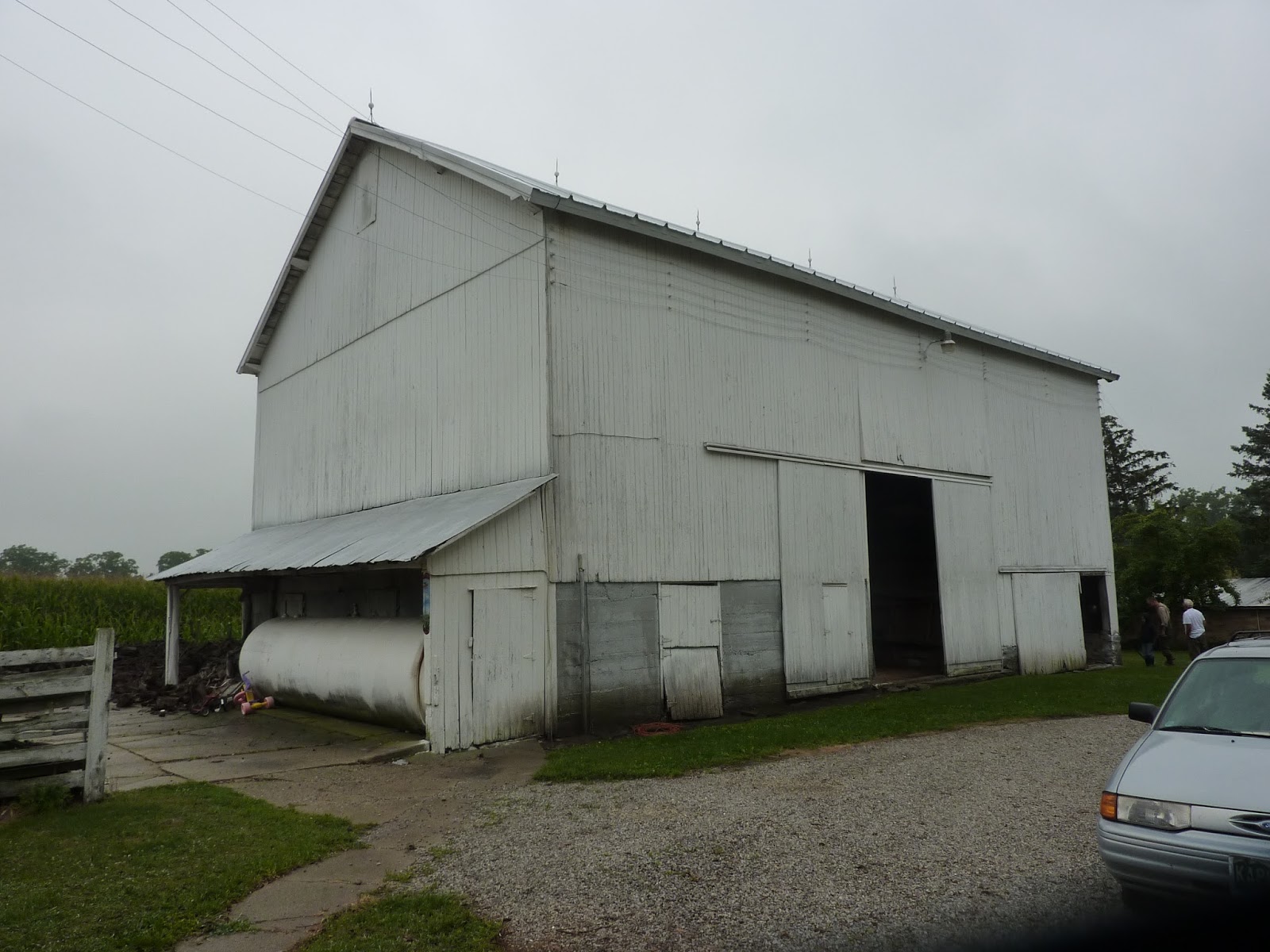
We've been in need of a machine shed for all the equipment we've accumulated.   Much of it we're able to keep indoors, but it makes doing just about anything difficult, requiring the constant shuffling of equipment to make a work space or get to another piece of equipment.  Most of what we use hasn't been manufactured for decades, so it seems a good idea to keep it under cover, holding the rust at bay for as long as possible.

The cheap solution is the typical pole building, but I'm not particularly excited about erecting something with treated pine or "engineered" beams made of OSB that will do little more than serve as a constant reminder of how crappy our building materials have become while we continue to inflate the human bubble.  I'd much prefer to put up a real barn, but they're expensive.

A friend of mine moved a barn, an impressive timber-framed structure in the way of an airport expansion, for little more than the cost of a similarly sized pole-building.  I recently found a well maintained barn not too far from us, being offered for free, so we're trying to figure out if we could afford to move it to our place.   As time-poor as I've been lately, it seems crazy to start such a project, but hopefully we'll be able to afford to pay for most of the work.

The farmer who is offering the barn clearly appreciates what he has.  It was erected by his grandfather in 1877 -- and shows real pride of workmanship.  He showed us the hand carved plaque his grandfather made, marking the barn's year of construction.

However, he recognizes that it no longer fits the needs of someone who has no livestock and farms 4,000 acres (which is typical here in the midwest).   "It's the chemicals -- the ones they came out with after the war -- that changed everything." he says.  "Before that, everyone could make a living on 80 or 160 acres, but not anymore."

Living here in Michigan, surrounded by the toxic and lifeless corn and soy desert, it's easy to assume that the few farmers who remain in business (we have more people in prison than we have farmers here in the U.S.) are fully on-board with the industrialized, chemically dependent agriculture that they practice.

I'm discovering that this is rarely the case.  These farmers are effectively the "last man standing", being beaten into a corner by our mindless corporate system that does little but find new ways to externalize costs and direct cash flow to a handful of corporate coffers.  Our food is cheap, but we're paying for it in ways that most of us have yet to even begin to fathom.

One retired farmer even suggested that "We made a big mistake when we left horses for tractors".   Though I would agree, I was both surprised and heartened to hear it from him.  Perhaps our sanity isn't as far gone as I'd thought.


Monday, July 22, 2013

Fat, corruption, and killer sandwiches

Healthcare in the US is expensive.  There's little doubt in my mind that much of this cost is the result of corruption, born of our corporately dominated society, healthcare industry lobbying to congress (Medicare part D anyone?), pharmaceutical industry bribing of doctors, or a populace willing to look the other way because they want their health industry retirement investments to grow.

However, there is a much overlooked and often completely ignored aspect to our healthcare costs.   We're not healthy, and because we're surrounded by people in the same condition, we don't seem to have noticed our long descent.

Moving to the midwest from Washington state was a real eye opener for me.   It was, in effect, like time travel to an increasingly obese future.  Check out the animated CDC chart at the bottom of this page showing obesity rates by state in the US since 1985.  I remember standing in line at the grocery store one day shortly after we'd first arrived.   I could see roughly 30 people around me, and it struck me that each and every one was obese!

There are numerous reasons for this problem.   Midwesterners, as a rule, live in a somewhat harsher climate than those on the west coast where I formerly lived.   As a result, outdoor exercise is a bit less appealing.   Michigan is ground zero of the car culture, and much of the culture here seems to view walking as a cruel task to which no human should be subjected to.   "Sports" are for spectators only, unless they involve a jetski or some other motorized form of transport.   Most men here seem to aspire to the ownership of a Harley rather than to climb a mountain or do something which requires physical activity.

All exercise aside though there is a perhaps greater problem that is not limited to the midwest, and one which grows worse each year.

We eat crap.  Crappy food leads to crappy health, both directly through actual consumption and perhaps more importantly by creating a crappy planet.  Let's analyze the ubiquitous Subway sandwich (you know - the sandwich that made Jared skinny!) and see just how crappy our food is.   (the analysis is of course representative of most food consumed in the US, not just Subway's product).

First of all, you're probably expecting me to talk about bleached flour, excessive salt, dangerous preservatives, high cholesterol, or empty calories.  Those may all be true, but since you already know about them, we'll just take that as a given.

The sandwich has four primary components:  buns, meat, cheese, and veggies.   Each one is probably directly harmful for you to consume, but also harmful to you because you happen to be unfortunate enough to live on the planet where they're produced.  The folks that produce them are effectively forced to do it the "wrong" way because they're part of a centralized corporate system where doing otherwise is a sure prescription for going bankrupt.

For all practical purposes, the bulk of the sandwich comes from four crops:  corn, soy, wheat, and vegetables (tomatoes, lettuce, etc -- which I'm grouping together because they're similarly grown).

Each of these crops likely involve the use of glyphosate (Monsanto's "Roundup").  All of the crops likely received glyphosate to kill weeds before the crop was planted, with the corn and soy receiving it as the crop grew, being that they're genetically modified for herbicide resistance.   The wheat can also be genetically modified, but is generally not.  Much of the US's wheat is grown for export to countries that are smarter than we are, and won't accept genetically modified crops (like Japan, which recently rejected US wheat shipments found to be contaminated with gmo wheat).   In fact, Monsanto recently petitioned the EPA to allow greater levels of glyphosate in our food, and was successful.

Glyphosate is designed to bond to chemicals required for the formation of an enzyme, which Monsanto famously touts as not existing in the human body.  That's only *half* true.   Our bodies don't directly need this enzyme, but the bacteria which are critical to our digestive and immune function DO require this enzyme, likely leading to many of the extreme allergies, autoimmune diseases, and nutritional deficiencies that result from damaged intestinal flora.

How important are your gut bacteria?   Much more so than I was ever aware.   Check out this recent eye opening article from Michael Pollan.  Their presence and diversity are directly responsible not just for digestion and nutrition, but also comprises the bulk of our immune systems, such that damaging them damages us.

Moving along back to our crops, it's safe to assume that each of them were fertilized with synthetic fertilizers, which are manufactured from natural gas (much of which is now fracked), which we've decided is more important than our groundwater.  The abundant nitrogen introduced in these fertilizers decays into nitrous oxide -- a potent greenhouse gas.   The nitrogen (and phosphate) fertilizers which are applied to midwest farms are now the primary cause of the Gulf of Mexico "dead zone", which has grown significantly over the last few decades.

This hardly bears saying, but I should also point out that the crops were invariably grown with diesel fueled tractors (more CO2 to the atmosphere), tilling soils that were once very high in organic matter which, when exposed to the atmosphere through regular tillage, oxidizes into CO2.   This destroy's the soils nutritional profile and drought tolerance, and is likely the single largest source of human caused CO2 emissions -- even exceeding our direct use of fossil fuels.

The wheat used in the buns is a new high-yielding dwarf variety, developed a few decades ago by Norman Borlaug during the "Green Revolution" (which has solved no problems that I'm aware of, but has created many).  It now contains a brand new protein in part of the gluten chain (gliadin), which is believed to be a likely culprit in the widespread emergence of gluten intolerance.  The same intolerance which sent me to the emergency room to the tune of several thousand dollars when my esophagus swelled from an allergic reaction.  The flip side of this is that much of the intolerance is likely a result of glyphosate use as well -- which as I just noted is also responsible for the decline in intestinal flora.  Antibiotic use also plays a likely role (as it likely did with my own gluten intolerance).

Let's move on to the corn and soy, which greatly dominate all farms here in the midwest.   These manifest in the sandwich's meat, or milk (for the cheese), for which they provide the livestock feed.  The corn was most likely also sprayed with Atrazine, a potent endocrine disruptor suspected of causing a number of different metabolic problems as well as breast and prostate cancer, and which is found in harmful levels in most midwest drinking water.   Strangely enough, it's banned for use in the home country of the manufacturer (Germany) and most of europe for precisely this reason.

So the corn and soy are animal feed, and are almost invariably fed to hogs, chickens, and cattle in CAFOs (confined animal feeding operations).   This is done because it's the cheapest way to raise livestock, at least so long as the diesel fuel keeps flowing.  There are a few downsides, aside from the obvious cruelty of crowded and unnatural conditions.   Concentrated populations of animals are highly susceptible to diseases, requiring the regular use of antibiotics, which leads to the antibiotic resistance that now regularly kills people in hospitals.  A friend of ours has a daughter who was nearly killed by a MRSA infection -- from a superficial scratch on her cheek.

Finally, we come to the veggies.   As a result of the requirement for near-perfect appearance, most vegetable crops in the US are subjected to heavy insecticide use, often being in the dangerous class of organo-phosphate pesticides.   Living in a rural area where such pesticides are often used results in an 80% increase in chances of developing parkinson's disease.  Workers in these fields (typically California or Florida) are regularly exposed to the pesticides, yielding horrible birth defects, as with the "Immokalee Three".  They've also been shown to end up in the bodies of people eating them at brain damaging levels, such as one study of Mercer Island (that's Bill Gate's neighborhood near Seattle) children showed.

So how do we solve these problems?   To sum it up, we need to de-industrialize our food system (and our entire society, but that's a topic for another day).  Remove the centralization.   Stop eating fast food (which as a matter of cost essentially *requires* the industrialized model).   Buy your food from small producers who (unlike large industrial producers) look you in the eye when they sell you a product, and who are more likely to have a conscience.   Buy meats and milk from animals that are pastured rather than fed chemically grown diets of grain.  Yes, it'll seem expensive, if you can ignore the externalized costs of the current system.


Saturday, June 15, 2013


In the movie series "The Terminator", a futuristic military computer network designed with the ability to learn, does exactly that.   The rate of learning grows exponentially to the point that it scares the human operators, who attempt to shut it down.  Sensing this as an attack, and humans as a primary threat, it launches a nuclear attack at Russia with the knowledge that this (and the imminent response) will alleviate the human threat.   Next, they unleash the shiny smiling robots to deal with the survivors...

I haven't noticed any mushroom clouds, nor have I been chased by any homicidal amalgam alloy robots  masquerading as police officers (well... not lately anyway), but I think we're now at the mercy of an entity which very much resembles Skynet.

As is often the case, the most insidious enemies aren't always the most obvious or the easiest to attack. In our case, they've fostered a dependence upon themselves which is at its worst in the "first world" industrialized countries.   Nobody wants to "bite the hand that feeds you", right?  Never mind the fact that we've lived just fine without them for 99.999% of our time on the planet.

Perhaps even worse is the fact that they've developed the ability to control our thoughts while making most of us think that we've arrived at our opinions independently.   In what amounts to a global case of stockholm syndrome, we actually like our captors.

We're all much more sheep-like than we like to admit.   Most of our opinions are arrived at through careful observation of our peers (actual or perceived) rather than through individual thinking.  This enemy tells us who our peers are and what "they" think.  Have you ever noticed the regular use of the term "some people say..."?  Advertising-supported media is their mouthpiece.  Look at the advertisers, and you'll see who controls your television programming and "news".

Just like Skynet, our invisible nemesis is attempting to exterminate us, as McKibben succinctly points out.  We'd be able to fight back if we could identify this fact, but most of us can't.   Our enemy is far too clever to allow that  -- and takes great pains to make sure we remain unaware.

Unlike Skynet, however, our enemy isn't really self aware.  Though comprised of actual humans, it more closely resembles a dumb robot.  At any given time, this Franken-monster is singularly focused on the maximization of shareholder returns for the next 90 day period, to the point that it engages in activities which are ultimately detrimental to its continued existence.   That would be a comforting flaw  if it weren't going to take us out first.

What's the best way to fight back, assuming you've successfully identified this enemy?  The first and most obvious (and most difficult) answer is to stop purchasing their products.    That means just about any manufactured good.   Gasoline.  Travel.  Cheap plastic crap from China.  Clothes made in places like this.  The best answer is often to go without.   Short of that, grow or make your own.   And if that's not possible, buy the expensive stuff made locally, or by the smallest company you can find.  As I said -- doing the right thing is never easy.  This will take more time and money than any of us have.  There will be compromise.

The next step?   Stop investing in your enemy.  Most folks I know are heavily invested in their own demise, whether through direct stock ownership or hidden in mutual funds in a 401k or IRA.  I know -- some of us are completely dependent upon investments for personal income, but at the very least, try to avoid investing in fossil fuel companies.  Not in control of your own pension fund investments?   Write them a letter.   They won't listen, but might if yours is one of thousands.   Get your city or university to divest, as many are now doing.