Sunday, August 4, 2013

Summer

Aside from a week in the mid 90's (while we were putting up our second cutting of hay, as dictated by this tradition of misery), this summer has been quite nice.  The pastures have stayed green, and I have yet to feed any hay.  The weather makes it easy to forget last year.  The heat isn't really gone though -- it's just toasting Europe and Asia this summer instead of us.

My day job makes farming difficult;  the extra hours of commuting effectively removed a day from my week.   I've cut way back on internet time (a good thing), but time is still tight, and I feel as if keeping my head above water with respect to our various farm duties is increasingly difficult.  The obvious answer seems to be to give up more of our farming endeavors, but they're the work I truly enjoy.  I still can't shake the notion that they may be all we have to fall back on when America finally has its Wile E. Coyote moment and looks down into the abyss.   It feels as if we're all in a game of musical chairs, but the music is playing much longer than I'd expected.   Sooner or later though, it's going to stop;  of that I'm quite certain...   I think.

We've been in need of a machine shed for all the equipment we've accumulated.   Much of it we're able to keep indoors, but it makes doing just about anything difficult, requiring the constant shuffling of equipment to make a work space or get to another piece of equipment.  Most of what we use hasn't been manufactured for decades, so it seems a good idea to keep it under cover, holding the rust at bay for as long as possible.

The cheap solution is the typical pole building, but I'm not particularly excited about erecting something with treated pine or "engineered" beams made of OSB that will do little more than serve as a constant reminder of how crappy our building materials have become while we continue to inflate the human bubble.  I'd much prefer to put up a real barn, but they're expensive.

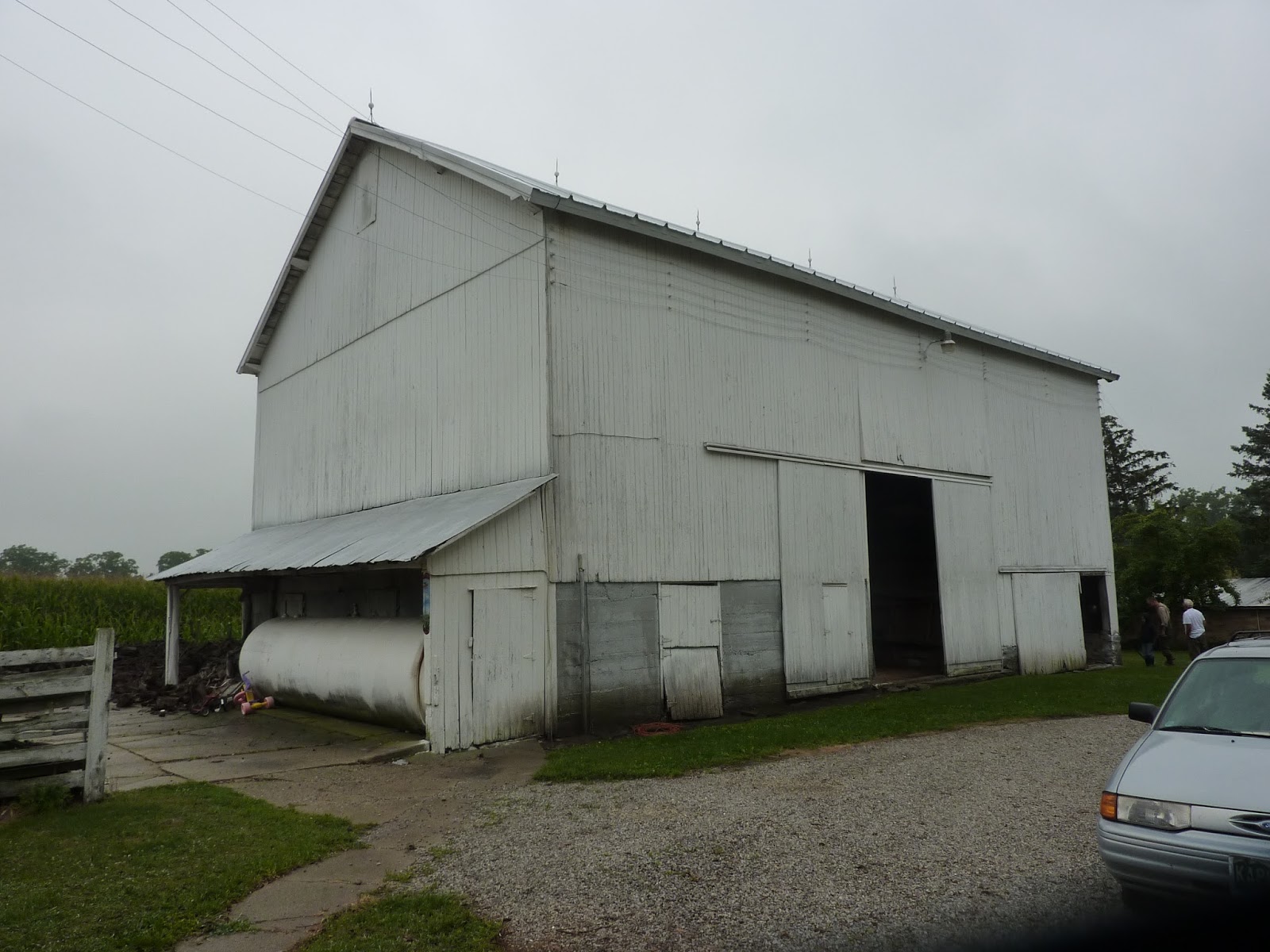
A friend of mine moved a barn, an impressive timber-framed structure in the way of an airport expansion, for little more than the cost of a similarly sized pole-building.  I recently found a well maintained barn not too far from us, being offered for free, so we're trying to figure out if we could afford to move it to our place.   As time-poor as I've been lately, it seems crazy to start such a project, but hopefully we'll be able to afford to pay for most of the work.

The farmer who is offering the barn clearly appreciates what he has.  It was erected by his grandfather in 1877 -- and shows real pride of workmanship.  He showed us the hand carved plaque his grandfather made, marking the barn's year of construction.

However, he recognizes that it no longer fits the needs of someone who has no livestock and farms 4,000 acres (which is typical here in the midwest).   "It's the chemicals -- the ones they came out with after the war -- that changed everything." he says.  "Before that, everyone could make a living on 80 or 160 acres, but not anymore."

Living here in Michigan, surrounded by the toxic and lifeless corn and soy desert, it's easy to assume that the few farmers who remain in business (we have more people in prison than we have farmers here in the U.S.) are fully on-board with the industrialized, chemically dependent agriculture that they practice.

I'm discovering that this is rarely the case.  These farmers are effectively the "last man standing", being beaten into a corner by our mindless corporate system that does little but find new ways to externalize costs and direct cash flow to a handful of corporate coffers.  Our food is cheap, but we're paying for it in ways that most of us have yet to even begin to fathom.

One retired farmer even suggested that "We made a big mistake when we left horses for tractors".   Though I would agree, I was both surprised and heartened to hear it from him.  Perhaps our sanity isn't as far gone as I'd thought.


Monday, July 22, 2013

Fat, corruption, and killer sandwiches

Healthcare in the US is expensive.  There's little doubt in my mind that much of this cost is the result of corruption, born of our corporately dominated society, healthcare industry lobbying to congress (Medicare part D anyone?), pharmaceutical industry bribing of doctors, or a populace willing to look the other way because they want their health industry retirement investments to grow.

However, there is a much overlooked and often completely ignored aspect to our healthcare costs.   We're not healthy, and because we're surrounded by people in the same condition, we don't seem to have noticed our long descent.

Moving to the midwest from Washington state was a real eye opener for me.   It was, in effect, like time travel to an increasingly obese future.  Check out the animated CDC chart at the bottom of this page showing obesity rates by state in the US since 1985.  I remember standing in line at the grocery store one day shortly after we'd first arrived.   I could see roughly 30 people around me, and it struck me that each and every one was obese!

There are numerous reasons for this problem.   Midwesterners, as a rule, live in a somewhat harsher climate than those on the west coast where I formerly lived.   As a result, outdoor exercise is a bit less appealing.   Michigan is ground zero of the car culture, and much of the culture here seems to view walking as a cruel task to which no human should be subjected to.   "Sports" are for spectators only, unless they involve a jetski or some other motorized form of transport.   Most men here seem to aspire to the ownership of a Harley rather than to climb a mountain or do something which requires physical activity.

All exercise aside though there is a perhaps greater problem that is not limited to the midwest, and one which grows worse each year.

We eat crap.  Crappy food leads to crappy health, both directly through actual consumption and perhaps more importantly by creating a crappy planet.  Let's analyze the ubiquitous Subway sandwich (you know - the sandwich that made Jared skinny!) and see just how crappy our food is.   (the analysis is of course representative of most food consumed in the US, not just Subway's product).

First of all, you're probably expecting me to talk about bleached flour, excessive salt, dangerous preservatives, high cholesterol, or empty calories.  Those may all be true, but since you already know about them, we'll just take that as a given.

The sandwich has four primary components:  buns, meat, cheese, and veggies.   Each one is probably directly harmful for you to consume, but also harmful to you because you happen to be unfortunate enough to live on the planet where they're produced.  The folks that produce them are effectively forced to do it the "wrong" way because they're part of a centralized corporate system where doing otherwise is a sure prescription for going bankrupt.

For all practical purposes, the bulk of the sandwich comes from four crops:  corn, soy, wheat, and vegetables (tomatoes, lettuce, etc -- which I'm grouping together because they're similarly grown).

Each of these crops likely involve the use of glyphosate (Monsanto's "Roundup").  All of the crops likely received glyphosate to kill weeds before the crop was planted, with the corn and soy receiving it as the crop grew, being that they're genetically modified for herbicide resistance.   The wheat can also be genetically modified, but is generally not.  Much of the US's wheat is grown for export to countries that are smarter than we are, and won't accept genetically modified crops (like Japan, which recently rejected US wheat shipments found to be contaminated with gmo wheat).   In fact, Monsanto recently petitioned the EPA to allow greater levels of glyphosate in our food, and was successful.

Glyphosate is designed to bond to chemicals required for the formation of an enzyme, which Monsanto famously touts as not existing in the human body.  That's only *half* true.   Our bodies don't directly need this enzyme, but the bacteria which are critical to our digestive and immune function DO require this enzyme, likely leading to many of the extreme allergies, autoimmune diseases, and nutritional deficiencies that result from damaged intestinal flora.

How important are your gut bacteria?   Much more so than I was ever aware.   Check out this recent eye opening article from Michael Pollan.  Their presence and diversity are directly responsible not just for digestion and nutrition, but also comprises the bulk of our immune systems, such that damaging them damages us.

Moving along back to our crops, it's safe to assume that each of them were fertilized with synthetic fertilizers, which are manufactured from natural gas (much of which is now fracked), which we've decided is more important than our groundwater.  The abundant nitrogen introduced in these fertilizers decays into nitrous oxide -- a potent greenhouse gas.   The nitrogen (and phosphate) fertilizers which are applied to midwest farms are now the primary cause of the Gulf of Mexico "dead zone", which has grown significantly over the last few decades.

This hardly bears saying, but I should also point out that the crops were invariably grown with diesel fueled tractors (more CO2 to the atmosphere), tilling soils that were once very high in organic matter which, when exposed to the atmosphere through regular tillage, oxidizes into CO2.   This destroy's the soils nutritional profile and drought tolerance, and is likely the single largest source of human caused CO2 emissions -- even exceeding our direct use of fossil fuels.

The wheat used in the buns is a new high-yielding dwarf variety, developed a few decades ago by Norman Borlaug during the "Green Revolution" (which has solved no problems that I'm aware of, but has created many).  It now contains a brand new protein in part of the gluten chain (gliadin), which is believed to be a likely culprit in the widespread emergence of gluten intolerance.  The same intolerance which sent me to the emergency room to the tune of several thousand dollars when my esophagus swelled from an allergic reaction.  The flip side of this is that much of the intolerance is likely a result of glyphosate use as well -- which as I just noted is also responsible for the decline in intestinal flora.  Antibiotic use also plays a likely role (as it likely did with my own gluten intolerance).

Let's move on to the corn and soy, which greatly dominate all farms here in the midwest.   These manifest in the sandwich's meat, or milk (for the cheese), for which they provide the livestock feed.  The corn was most likely also sprayed with Atrazine, a potent endocrine disruptor suspected of causing a number of different metabolic problems as well as breast and prostate cancer, and which is found in harmful levels in most midwest drinking water.   Strangely enough, it's banned for use in the home country of the manufacturer (Germany) and most of europe for precisely this reason.

So the corn and soy are animal feed, and are almost invariably fed to hogs, chickens, and cattle in CAFOs (confined animal feeding operations).   This is done because it's the cheapest way to raise livestock, at least so long as the diesel fuel keeps flowing.  There are a few downsides, aside from the obvious cruelty of crowded and unnatural conditions.   Concentrated populations of animals are highly susceptible to diseases, requiring the regular use of antibiotics, which leads to the antibiotic resistance that now regularly kills people in hospitals.  A friend of ours has a daughter who was nearly killed by a MRSA infection -- from a superficial scratch on her cheek.

Finally, we come to the veggies.   As a result of the requirement for near-perfect appearance, most vegetable crops in the US are subjected to heavy insecticide use, often being in the dangerous class of organo-phosphate pesticides.   Living in a rural area where such pesticides are often used results in an 80% increase in chances of developing parkinson's disease.  Workers in these fields (typically California or Florida) are regularly exposed to the pesticides, yielding horrible birth defects, as with the "Immokalee Three".  They've also been shown to end up in the bodies of people eating them at brain damaging levels, such as one study of Mercer Island (that's Bill Gate's neighborhood near Seattle) children showed.

So how do we solve these problems?   To sum it up, we need to de-industrialize our food system (and our entire society, but that's a topic for another day).  Remove the centralization.   Stop eating fast food (which as a matter of cost essentially *requires* the industrialized model).   Buy your food from small producers who (unlike large industrial producers) look you in the eye when they sell you a product, and who are more likely to have a conscience.   Buy meats and milk from animals that are pastured rather than fed chemically grown diets of grain.  Yes, it'll seem expensive, if you can ignore the externalized costs of the current system.


Saturday, June 15, 2013


In the movie series "The Terminator", a futuristic military computer network designed with the ability to learn, does exactly that.   The rate of learning grows exponentially to the point that it scares the human operators, who attempt to shut it down.  Sensing this as an attack, and humans as a primary threat, it launches a nuclear attack at Russia with the knowledge that this (and the imminent response) will alleviate the human threat.   Next, they unleash the shiny smiling robots to deal with the survivors...

I haven't noticed any mushroom clouds, nor have I been chased by any homicidal amalgam alloy robots  masquerading as police officers (well... not lately anyway), but I think we're now at the mercy of an entity which very much resembles Skynet.

As is often the case, the most insidious enemies aren't always the most obvious or the easiest to attack. In our case, they've fostered a dependence upon themselves which is at its worst in the "first world" industrialized countries.   Nobody wants to "bite the hand that feeds you", right?  Never mind the fact that we've lived just fine without them for 99.999% of our time on the planet.

Perhaps even worse is the fact that they've developed the ability to control our thoughts while making most of us think that we've arrived at our opinions independently.   In what amounts to a global case of stockholm syndrome, we actually like our captors.

We're all much more sheep-like than we like to admit.   Most of our opinions are arrived at through careful observation of our peers (actual or perceived) rather than through individual thinking.  This enemy tells us who our peers are and what "they" think.  Have you ever noticed the regular use of the term "some people say..."?  Advertising-supported media is their mouthpiece.  Look at the advertisers, and you'll see who controls your television programming and "news".

Just like Skynet, our invisible nemesis is attempting to exterminate us, as McKibben succinctly points out.  We'd be able to fight back if we could identify this fact, but most of us can't.   Our enemy is far too clever to allow that  -- and takes great pains to make sure we remain unaware.

Unlike Skynet, however, our enemy isn't really self aware.  Though comprised of actual humans, it more closely resembles a dumb robot.  At any given time, this Franken-monster is singularly focused on the maximization of shareholder returns for the next 90 day period, to the point that it engages in activities which are ultimately detrimental to its continued existence.   That would be a comforting flaw  if it weren't going to take us out first.

What's the best way to fight back, assuming you've successfully identified this enemy?  The first and most obvious (and most difficult) answer is to stop purchasing their products.    That means just about any manufactured good.   Gasoline.  Travel.  Cheap plastic crap from China.  Clothes made in places like this.  The best answer is often to go without.   Short of that, grow or make your own.   And if that's not possible, buy the expensive stuff made locally, or by the smallest company you can find.  As I said -- doing the right thing is never easy.  This will take more time and money than any of us have.  There will be compromise.

The next step?   Stop investing in your enemy.  Most folks I know are heavily invested in their own demise, whether through direct stock ownership or hidden in mutual funds in a 401k or IRA.  I know -- some of us are completely dependent upon investments for personal income, but at the very least, try to avoid investing in fossil fuel companies.  Not in control of your own pension fund investments?   Write them a letter.   They won't listen, but might if yours is one of thousands.   Get your city or university to divest, as many are now doing.


Friday, June 7, 2013

Farming gone bad

Back when we lived in Washington, we'd feel all smug when we were eating our own eggs from the backyard coop, maybe with a little cider we'd pressed from scavenged apples.

Nowadays the majority of our food at most meals is home grown.  "Farm food", as we call it, is not something to look forward to in Henry's mind.   However, there are exceptions.   These popcorn balls are entirely home-grown -- the popcorn, maple syrup, and butter.  Popped on homegrown fuel.  We even harvested our own salt, scraping it from the horses after a hard and sweaty day's work.  Okay -- maybe not the last part.  

Making our own junk food is fun.

Saturday, March 23, 2013

Evil

As of the last few weeks I'm back among the gainfully employed, and am no longer calculating how many wooden spoons I'd have to carve each day to avoid homelessness.  One of the many perks of my new 1.5 hour commute time is the fact that I have an hour and a half to listen to audio books.

The first book I chose is a NY Times bestseller  -- Confessions of an Economic Hitman.  The author worked as an economic forecaster working for the Chas T. Main company - a defunct consulting and engineering firm on the order of Halliburton or Bechtel (made famous for their excellent support of our soldiers in Iraq or their excellent service to the citizens of Paraguay).

The author details his marching orders -- to provide wildly optimistic economic forecasts for various countries which would only come to pass if Main's engineering projects (typically financed by entities such as the World Bank or the IMF) were put into motion.  The leaders of whichever country they were working in were invariably sold on the projects with threats, bribery, or the knowledge of what happened to peers who refused such deals.

The country receiving the loans for these projects invariably defaults, while the engineering firms waddle home with pockets full of cash.   I don't know how they manage to get such projects financed so often, but I suspect they have good lobbyists.

Leaders who refused the terms of such projects invariably met with untimely deaths after being vilified as communist dictators or defamed in some way.  Panama's Omar Torrijos knew full well what the consequences of his refusal would be, and accurately predicted the means of his own assasination.  Ecuador's Jaime Roldós Aguilera met a similar fate, despite maintaining a second decoy aircraft whenever he traveled.   Between that, and our similar involvement in installing Augusto Pinochet in Chile (what's not to like about dismembering people in a soccer stadium?), or installing the Shah in Iran, our government has been up to quite a few things over the last few decades which some of us might not approve of.

Have you ever wondered why it is that as 5% of the world's population, we're able to consume roughly 25% of the world's energy resources?   This sort of activity on our behalf is exactly what has enabled it. Well... either that or the fact that Americans are infinitely better than the people of other countries.  As the keepers of the world's reserve currency, we don't even need to worry about countries that go delinquent on their loans.  We just print a little more, while strong-arming the countries and getting favors like votes in the UN.  Sounds like the mafia, eh?

So does this make Americans evil?   Much of the world seems to think so, because they see our actions in their countries rather than the propaganda you and I see on TV about places we've never been.  I guess it all depends on your definition of evil.   As Americans, we all know full well that evil people are driven by diabolical motives, perhaps with a touch of insanity.  You know... like Lex Luthor or Batman's Joker.   We're not like that, so we're not evil, right?

I'd suggest that the evil as it's presented to us by Hollywood doesn't really exist.  I've never met anyone even remotely resembling the Hollywood definition of evil.

True evil, as I see it, is comprised mostly of two traits.   Greed and indifference.  Greed is a pretty natural trait.   We've all felt it at one time or another.  Most of the time, however, our greed is tempered by social pressures, or simply the knowledge that acting on impulses of greed tends to have negative consequences that exceed any benefits.  Indifference is the key enabler to greed.  As a country, few are more indifferent than the US.  Our knowledge of foreign geography, cultures, and languages is among the worst of any country.  It's much easier to be indifferent towards people you don't know or understand.  

Are Americans evil?  My ancestors kept slaves in North Carolina.  Though I'm sure they never considered themselves evil, many would consider slavery an evil pursuit.  I regularly indulge in exorbitant quantities of energy (by historical if not by contemporary American standards), which I know full well leaves a world like this or this to future generations, including my own family.  I don't like to think of myself as evil though.  Would my descendants agree?


Friday, January 25, 2013

The Perfect Human Trap?

Many folks I've met of the "boomer" generation don't seem to share the same sense of urgency about environmental and climate issues as the younger generations.  My father, for instance, often cites massive improvements made in the US over his lifetime, such as the fact that the Cuyahoga river no longer catches fire, or the fact that there is no longer a 20 mile long black cloud downwind of Gary, Indiana.  When an environmental problem became unbearably bad during his life, it was generally taken care of in one way or another, and I suspect that most members of his generation have been conditioned to think that we can take care of any problems after they occur.

The problem is that the issues we're now encountering are global in scope, and are fundamental risks to the very life support systems we require to survive.  We can't just move away from them until they're dealt with.  As they grow worse, our ability to deal with them decreases as we become more concerned with surviving the day instead of the decade or century.

While this is disconcerting enough on its own, there's an even bigger problem.  Our use of fossil fuels has doubled approximately every 20 years.  Roughly 75% of all the fossil fuel ever burned has been burned within the last 40 years.  It takes a minimum of 40 years for our carbon emissions to take effect, as a result of  the biosphere's thermal inertia (oceans in particular).  This means that we need to react 40 years before the changes take place if they are to be avoided!

Another complicating factor is the fact that the changes we make are not linear in nature.   Early on, most of our emissions were absorbed by the oceans or by plant life, but we've long since exceeded the absorptive capacity of the biosphere, as evidenced by the recent dramatic climbs in atmospheric carbon.  We've now triggered some massive feedback loops which will exacerbate our emissions even further.  Climate change has turned the Amazon rainforest -- a massive carbon sink -- into a carbon emitter, as drought and wildfire sweep through the formerly lush forest.  Changing climate zones mean that the forest outside your home will most likely be gone within 20 years (forests can handle slow change -- which isn't what we've triggered).   Carbon stored in the arctic refrigerator as soil organic matter in the permafrost, or as clathrates in the arctic ocean is now venting into the atmosphere at explosive rates.  Should we wait to see what happens?


Tuesday, January 22, 2013

The Dairy

The attack came swiftly, while I was seated with my back turned.  The bull drove his horns into the small of my back and twisted, attempting to knock me over so that he could trample me and finish the job.  I braced myself to stay upright, away from his deadly hooves.  He relented for a few seconds before returning with renewed vigor, swinging his head from side to side and prancing about like a boxer in the ring.  I turned back to face him as he approached the second time.  He slowly drew close, sniffed my beard, wrapped his tongue around it and tried to pull it off (I suppose it looks a bit like hay), shortly before ambling away to lick one of our barn cats.  She loved the attention.

Gomer
Fortunately for me, Gomer the bull is only eight weeks old and doesn't weigh very much.  His horns were about the size of a really big pimple before we burned off the buds. When he's not attacking me, he's a vicious killer of straw bales.  Juniper, his 350lb year-old accomplice (who does still have horns), is experiencing a renewed youth inspired by Gomer, and now attacks me regularly as well.   She's mostly looking for a good chin-scratching though.

We've thus far been using AI for our breeding.  That's AI as in Artificial Insemination -- we won't be using the other type of AI here (our farm is robot-free!).  Initially I had outsourced it, but finally took a course and have been doing it myself for a little over a year now.  Aside from the initial elation associated with sticking my arm up a cow's butt, I can't say I've been all that impressed with it.  We've had some successes, but not nearly what I'd hoped for.  So, when our cow Gertie gave birth to a bull calf, I decided that we might try something different.  If a bull isn't castrated, there is a window of perhaps 6 months during which he will be capable of breeding but not yet aggressive.

Jersey bulls have a reputation as the worst of the worst, though I've seen a few which were fairly docile.  I'm a little apprehensive of taking this route, but we're going to give it a try.  Chances are we'll butcher him as we would a steer at around two years of age, but hopefully will get some cows bred as part of the deal.  It's just like getting to "have your cake and eat it too", only a bull isn't typically covered in rich and creamy frosting.

Before I started kindergarten, two of my favorite books were Dr. Doolittle and Where the Wild Things Are.  I loved the idea of working together with animals, especially big ones.  Even if they were monsters.  Perhaps there's some epigenetic memory embedded in the recesses of my brain, of experiences had by my father or his parents back on my great-grandparent's farm.  Judging by my last name (Veale), the fascination with cows has spanned quite a few generations.

Though I would've at one time been horrified by the very thought of being tied to the daily dairy chores without end, there is a certain enjoyment that comes from a daily routine with these gentle beasts.  They're affectionate, playful (seen this video of our first cow?) creatures, with loads of personality.  It's easy to grow attached, and think of the cows as friends.

The downside to all this is that the primary purpose of a dairy is to produce milk.  When a cow doesn't respond to breeding, (as appears to be the case with two of my favorites), she ceases to produce milk.  She then becomes an enormously expensive pet, whose best use is to become hamburger.  It's tough to turn your friends into hamburger, but such is the life of a dairy farmer, I suppose.  I'm still holding out hope though... both Maggie and Josie skipped their last heat cycle.  Maybe they read my thoughts and decided they'd better get pregnant if they didn't want to visit freezerland.  I've got my fingers crossed!

Morning in the barn